Noto 2026 — Sicily's Most Beautiful Baroque City
Noto is the only town in the Val di Noto entirely rebuilt on a new site after the 1693 earthquake. Golden stone, pure Baroque, three squares in a row along the Corso — and the Infiorata flower festival in May, among Sicily's most spectacular events.
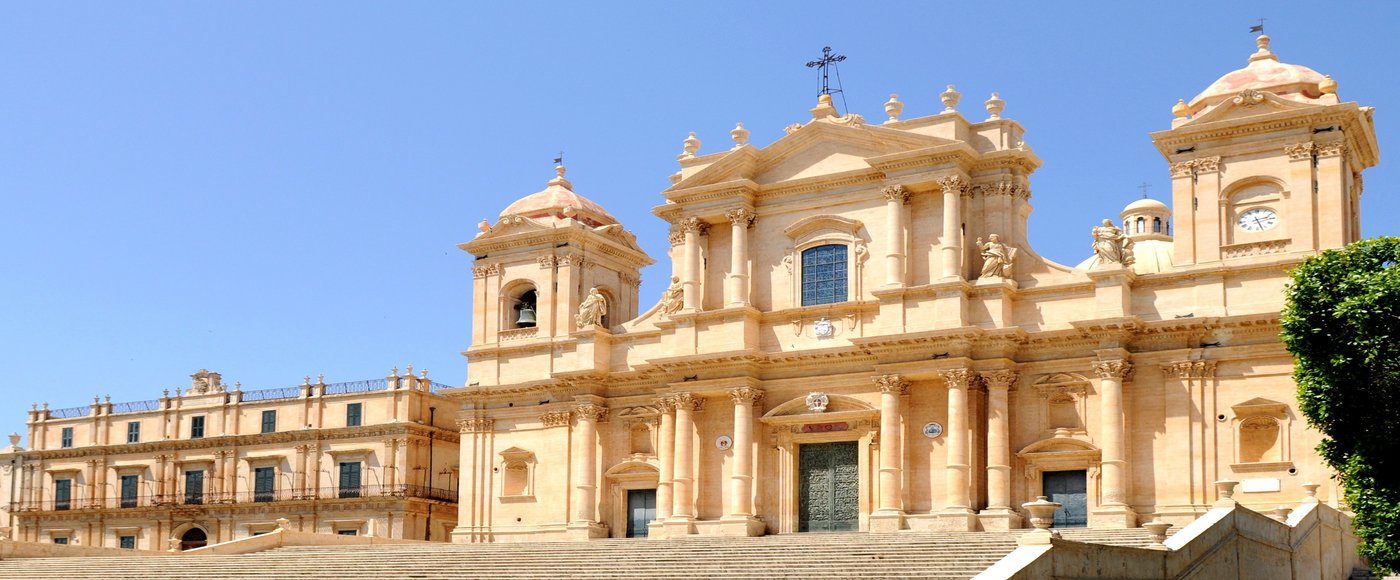
The Cathedral of San Nicolò — Sicily's Most Photographed Staircase
The Cathedral of San Nicolò dominates Noto from the top of Sicily's most photographed Baroque staircase. The three-tiered façade in honey-yellow limestone — built between 1694 and 1776 — is flanked by two asymmetrical bell towers and overlooks Piazza Municipio with an almost theatrical symmetry seemingly designed for photography.
In 1996, after decades of neglect and water infiltration, the dome collapsed at night without casualties. The reconstruction, completed in 2007, became an open-air workshop: thousands of people followed the work for years, making the restoration a collective story. The rebuilt dome is visible from the interior with its recovered original stucco decoration. The interior houses 18th-century paintings, votive silver, and the tomb of Conrad of Swabia — the young Hohenstaufen claimant beheaded in Naples in 1268, whose remains, according to tradition, rest here.
The staircase in front of the Cathedral is Noto's natural stage: people sit there at sunset, meet after Sunday mass, and take photos. It's one of Italy's most beautiful public spaces.
Palazzo Nicolaci di Villadorata — Mythological Balconies
Palazzo Nicolaci di Villadorata (1737) is Noto's most elaborate Baroque palace and one of the most extraordinary in all of Sicily. The six balconies on the façade along Via Corrado Nicolaci feature the richest corbels in Iblean Baroque architecture: winged horses, sirens, sphinxes, grotesque figures, and mythological monsters carved with unparalleled expressive freedom. Each corbel tells a different story — it's like reading a medieval bestiary sculpted in stone.
Today, the palace houses the Town Hall and some private apartments. Part of the noble rooms — the frescoed gallery, the ballroom, the private chapel — can be visited on weekdays by reservation or during special events like the Infiorata. The Nicolaci family was one of the most powerful in Bourbon Sicily: building the city's most lavish palace was a political as well as an artistic statement.
Corso Vittorio Emanuele — Three Squares in a Row
Corso Vittorio Emanuele is the backbone of Noto and one of Italy's most elegant urban axes. Approximately 700 meters long, it is entirely paved with black lava stone that contrasts with the warm yellow of the buildings. Three squares are arranged at regular intervals like scenic backdrops in an open-air theater: Piazza dell'Immacolata (with the Church of San Francesco and the Convent of the Friars Minor), Piazza Municipio (with the Cathedral and Palazzo Ducezio), and Piazza XVI Maggio (with the Theater and the Fountain of Hercules).
Palazzo Ducezio — Noto's town hall opposite the Cathedral — features the Hall of the Anapo Venus, a neoclassical frescoed gallery that is among Sicily's most elegant civic interiors. The name recalls Ducezio, the Sicilian leader who founded the first Noto in the 5th century BC. Teatro Vittorio Emanuele, inaugurated in 1870, hosts the theatrical season and summer concerts in its courtyard with the Baroque façade as a backdrop.
In the evening, the Corso transforms: cafes put out their tables, people stroll, the aromas from pastry shops mingle with the warm air. This is where Noto reveals itself not just as a monument but as a living city.
The Infiorata of Noto 2026 — When and What to Expect
The Infiorata of Noto is one of Sicily's most spectacular events. Every year, on the third weekend of May, Via Corrado Nicolaci is covered with a floral arrangement of almost 200 square meters, created with fresh flower petals by local master florists. The theme changes each year — mythological figures, historical scenes, abstract compositions — but the result is always of extraordinary ephemeral beauty: it lasts two days, then disappears.
Preparation begins on Friday evening with the drawing of the sketch on the pavement. On Saturday morning, volunteers arrange the petals with tweezers and spatulas in a few hours of frantic work. The composition is inaugurated on Saturday afternoon with a ceremony and the scattering of petals from the balconies of Palazzo Nicolaci. It is visible until Sunday evening, when visitors are traditionally invited to walk on the flowers in a collective celebration.
In 2026, the Infiorata is expected around May 16–17. During the weekend, Noto fills with visitors from all over Sicily and abroad — book accommodation at least a month in advance.
History — From the 1693 Earthquake to the Baroque Revival
Noto exists twice. The first Noto — Noto Antica — was a medieval settlement on a plateau 8 kilometers from its current location, with roots in the Bronze Age and the Greek era. It was the seat of the Sicels, the pre-Greek indigenous people, and then a Roman municipality, an Arab fortress, and a Norman fiefdom. A city with three thousand years of history.
On January 11, 1693, the Val di Noto earthquake — estimated magnitude between 7 and 7.4 — destroyed it almost completely. Duke Francesco Maria Landolina and the Spanish viceroy, Duke of Camastra, decided not to rebuild on the old site but to found a new city lower down, on a gently sloping limestone terrace that would facilitate water drainage. It was a revolutionary choice.
The best architects of the time — Rosario Gagliardi, Paolo Labisi, Vincenzo Sinatra — designed Noto as a unified work, with perpendicular streets, symmetrical squares, and coordinated façades. The result is unique in Europe: a completely planned Baroque city, built all in the same period with the same local limestone. There is nothing like it elsewhere. In 2002, the Late Baroque towns of the Val di Noto — Noto, Modica, Ragusa, Scicli, Caltagirone, and three other towns — were recognized as a UNESCO World Heritage Site.
Noto Antica — The City That No Longer Exists
8 km from modern Noto, on a limestone plateau accessible by a dirt road, lie the remains of the old medieval city. It is not a developed site: there are no ticket offices, information panels, or marked paths. There are ruins, crumbling walls, the silhouette of a church, the remains of the Norman castle that controlled the valley. And absolute silence.
For those who love archaeology and history, Noto Antica is worth the detour. It gives a sense of how radical the decision was to abandon everything and start from scratch — and helps understand why the new city, built with such collective determination, reached such high aesthetic levels.
Gastronomy — IGP Almonds, Granita, and Pastries
Noto is famous throughout Sicily for two products: Noto IGP almonds — considered the best in Italy for their aroma and flavor intensity — and artisanal gelato. Gelateria Costanzo, on Via Silvio Spaventa, has been considered one of Sicily's best gelaterias for decades. The must-try flavor: Noto almond in granita or as gelato, with a freshly baked local brioche.
The market on the Corso offers typical gastronomic specialties: *scacce* (pastry sheets filled with tomato and caciocavallo cheese), *mpanatigghi* (pastries with minced meat and chocolate, an Arab heritage), cassata, and cannoli with sheep's ricotta. For a full meal, trattorias in the alleys parallel to the Corso offer Pasta alla Norma, *sarde a beccafico* (baked sardines), and fish dishes at much lower prices than restaurants facing the main square.
Noto's typical breakfast — almond granita with brioche — is one of southern Sicily's most authentic gastronomic experiences. Don't skip it.
Vendicari Nature Reserve — Wild Beaches and Flamingos 15 km Away
Just 15 km from Noto lies the Vendicari Nature Reserve, one of eastern Sicily's most beautiful protected areas. The reserve includes coastal lagoons, freshwater ponds, and nearly wild sandy beaches. In spring and autumn, it's a major stopover for migrating birds: flamingos, herons, storks, cranes, and dozens of shorebird species are common sightings even for non-expert birdwatchers.
Vendicari's beaches — Calamosche, Marianelli, and San Lorenzo — are among the most beautiful and unspoiled in eastern Sicily, with crystal-clear waters and sandy seabeds. Access is free, but parking fills up quickly in summer. The medieval Swabian Tower and the ruins of an 19th-century tuna fishery complete the landscape with their silent presence.
Noto vs. Modica vs. Ragusa — Which to Visit?
| Aspect | Noto | Modica | Ragusa Ibla |
|---|---|---|---|
| Atmosphere | Elegant, museum-like | Lively, authentic | Romantic, picturesque |
| Key Event | Infiorata (May) | ChocoModica (October) | Patron Saint Festival (August) |
| Gastronomy | Almonds, Granita | IGP Chocolate | Ristorante Duomo ⭐⭐ |
| From Modica | 55 km · 50 min | — | 15 km · 20 min |
| Nearby Beaches | Vendicari (15 km) | Marina (12 km) | None direct |
| Recommended Time | Half a day | 1–2 days | Half a day |
The verdict: if you have only one day, Modica + Ragusa Ibla is the most efficient pairing (only 15 km apart). If you have two, add Noto and Scicli. If you have three, you can cover the entire UNESCO Val di Noto.
Where to Stay in Noto
Noto offers quality accommodation in its historic center: B&Bs and small hotels in Baroque palaces along the Corso and side streets, with rooms often retaining original majolica floors and frescoed ceilings. Prices in high season (July–August and during the Infiorata) start from €80–€120 per night for two people.
Those who prefer the countryside or coast will find excellent agriturismo accommodations in the surrounding areas, 5–15 km from the center. For day-trippers from Modica, accommodation isn't necessary, but if you want to visit Vendicari at sunset, staying overnight in Noto is the most convenient option.
How to Get to Noto from Modica
| Mode | Details |
|---|---|
| 🚗 Car | SP44 → SS115 · 55 km · 50 minutes |
| 🚂 Train | Modica → Syracuse (change) → Noto · ~1h30 |
| 🅿️ Parking | Piazza d'Armi parking (paid) or free areas on the outskirts |
Itinerary — Noto in Half a Day
| 1:30 PM | Arrival and parking on the outskirts of the center |
| 1:45 PM | Lunch at a trattoria in the alleys off the Corso |
| 3:00 PM | Cathedral of San Nicolò — staircase and interior |
| 3:45 PM | Palazzo Ducezio and Palazzo Nicolaci — the mythological balconies |
| 4:30 PM | Corso Vittorio Emanuele — Gelateria Costanzo, almond granita |
| 6:00 PM | Return to Modica or detour to Vendicari for sunset |
Noto in English — Complete Guide 2026
Noto is one of the finest examples of Baroque architecture in the world and a UNESCO World Heritage Site since 2002. Unlike other towns in the Val di Noto, Noto was completely rebuilt on a new site after the devastating 1693 earthquake, giving it an unusually unified Baroque character — every building in warm honey-coloured limestone, every street aligned, every façade coordinated.
Must-see: the Cathedral of San Nicolò and its dramatic staircase; Palazzo Nicolaci di Villadorata with its extraordinary mythological balcony figures; the elegant Corso Vittorio Emanuele with its three scenic piazzas; and Palazzo Ducezio with its neoclassical gallery.
Best time to visit: May for the Infiorata flower festival (third weekend, usually 16–17 May 2026); September–October for mild weather and fewer crowds. Getting there from Modica: 55 km by car (50 minutes) via the SS115. Nearby: Vendicari nature reserve and beaches (15 km), Syracuse (30 km), Scicli (35 km). Half a day is enough to see the main sights; combine with a beach afternoon at Vendicari for a full day trip.
Frequently Asked Questions About Noto
How far is Noto from Modica?
55 km, 50 minutes by car via SP44 and SS115.
When is the Infiorata of Noto 2026?
The third weekend of May, around May 16–17, 2026.
Is it worth visiting Noto on a day trip from Modica?
Absolutely. Leave Modica in the late morning, have lunch in Noto, visit the center in the afternoon. If you want to add Vendicari, leave earlier.
Is Noto Antica worth visiting?
Yes, for history buffs. The ruins of old Noto, 8 km away, are freely accessible and offer a evocative glimpse of the city before 1693. Don't expect tourist facilities: it's a partly wild site, walkable with comfortable shoes.
Is Noto suitable for families with children?
Yes. The Corso is flat and easy to navigate with strollers. The almond gelato and granita win over children. Vendicari is perfect for families in summer. The Cathedral staircase is steep but not mandatory.
Noto or Modica — which to choose?
They are complementary, not alternatives. Noto is more elegant and uniform, ideal for architecture and photography. Modica is livelier, more vertical, with its IGP chocolate and a more popular identity. Those who can should visit both — they are 50 minutes apart.
Recommended Tour
From Syracuse: Minivan Tour to Noto, Ragusa, and Modica
A day in the heart of Sicilian Baroque with an expert guide.
Recommended Tour
From Catania: Baroque Tour of Noto, Modica, and Ragusa Ibla
Noto, Modica, and Ragusa Ibla in one day with an expert guide. Departure from Catania.
You love Baroque architecture in its purest form, want to see the Infiorata in May, are looking for a half-day trip from Modica, or want to combine culture and beach at Vendicari.
Ask ModicaAI
Want to plan your visit to Noto? Ask the AI assistant for itineraries, accommodation, restaurants, and everything you need.
Open ModicaAI →